Everything I saw this week reminded me of one thing—incompletion. Clutter. I open my notes app and I see hundreds of drafts, brimming with half-formed, incomplete thoughts. The kind of lines that began with clarity but trailed off into ellipses. The kind of ideas that came in a rush at 1:14 a.m., only to be abandoned by 1:17 a.m. Even offline, the same pattern lingered. Half-done chores, drawers pulled open but not quite cleared, old mementos shifted from one corner to another (in the name of tidying up) but never really put away.
They resemble half-carved statues. The ‘could have been but never was’. So much potential but so dead too—decked away somewhere in a corner in this small, tiny box called my phone. A museum of fragments. Some beautiful, some haunting. Some embarrassing. All of them unfinished.
And yet, there’s something oddly moving about this pile of incompletions.
This post is dedicated to this, incompletion.
The True Self in Unfinished Work
I gaze deeply at the half-written essay I wrote in 2023 about subsistence specialisation and its influence on language development among early humans.
It starts boldly. With a strong thesis statement, a succinct abstract provides an overview of the central ideas to be argued in the paper. I continue reading and find… well, nothing.
A gaping silence where arguments were meant to be. Paragraphs never fleshed out. Titles hanging mid-thought. I find myself feeling rather embarrassed, and I want to hide this piece away again in the trenches of my bookshelf, under layers of papers long forgotten.
This work is not worth being seen or entertained by anyone—not even by me.
Then, I recall that when I started writing this piece, some feelings of uncertainty kept me from continuing it. My undergraduate self decided that this topic, though interesting to me, was not worth writing about, and it was banished to the chasm of my shelves.
As I stare longer at this piece of writing, I realise how this half-written piece reveals something about me rather than about subsistence specialisation. Or its influence on language. Or language development among early humans.
I find something about myself. This fragment holds value—not in a scholarly way, but in what it reveals.
The revelation that this half-written essay holds within it and remembers my former questions, my curiosity, and my hopes. That tremble beneath the thesis. That courage it took to start without certainty. That honesty of an interrupted thought. I find, in this abandoned page, not a failure but a mirror.
Maybe this unfinished essay will be finished one day when I am someone ‘more’?
While completed works are polished and refined, often striving for perfection, I find that unfinished pieces reveal a rare and raw vulnerability. They capture the in-between—the shifting identities, the quiet evolutions, the moments of becoming. And that, too, is a form of artistic expression, isn’t it?
Michelangelo’s unfinished sculptures—The Awakening Slave, The Young Slave, The Bearded Slave, and The Atlas (or Bound)—have sparked much discussion and debate over the decades. Do these statues symbolise Michelangelo’s strive for excellence or lack of effort? Why did he jump from one task to the next without finishing the first one? Do his vacillating visions in art reveal something about him as an artist?
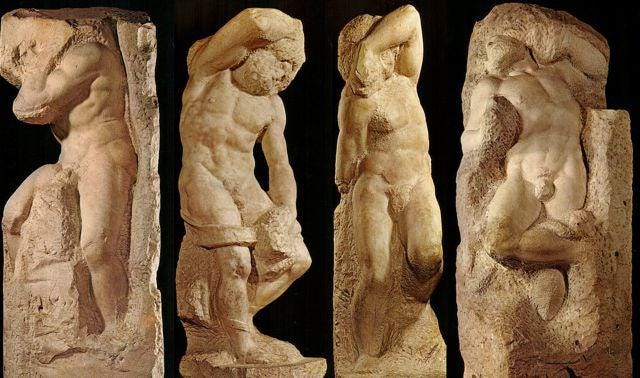
Perhaps the answer lies not in seeking a tidy explanation, but in recognising that unfinished works carry their own quiet form of completeness—one shaped by tension, interruption, and the spaces in between. They invite us to imagine what could have been, and in doing so, reflect on the process rather than the product. They speak of evolving visions, shifting emotions, and the honest reality that our effort to create something is rarely linear.
Maybe, what is left undone tells the most human story of all.
Unfinished Work: A Personal Repository
Some of these drafts I have date as far back as 2016. I’m not sure how I managed to preserve them—given the many changes in handphones, lost passwords, and my chronic lack of discipline in backing up data—but here they are.
Looking back at these drafts was an emotional ride.
The notes I had written in 2016 when I had no idea what the future was going to bring me, read like whispers from another life. Some were wide-eyed and hopeful, others drenched in uncertainty. I see in them the raw outlines of someone still learning how to put feelings into words, someone still fumbling through questions that were hard to name.
It’s strange and oddly touching—to find parts of myself that I did not know I had left behind.
These unfinished works are more than just discarded ideas—they are timestamps. Time capsules that, when opened years later, offer a glimpse into the path you’ve taken. They invite you to ask: Where was I then? And how did I get here?
For example, I found a draft I wrote in 2020—some thoughts on the values and principles that mattered to me in a career. Even though time has moved on, and I’ve become more weathered, more seasoned, with a vision that has ripened in its own way, that note still speaks to the core of who I was—and, in many ways, who I still am.
There’s also that quiet sense of wonder—how much time has flown. So many seasons have come and gone, each leaving their own imprint. What once felt recent now carries the weight of distance, like a past life folded into memory.
In those years, so much pain and joy have been felt. Inevitably, they have found their way into these notes—in between the lines, beneath the phrases, shaping the tone and intention. Even the unfinished ones hold traces of what was lived, endured, and cherished.
And my dear readers, if you haven’t done this exercise and you’re willing to do so, please do it. Scroll through your old notes, your voice memos, and your drafts.
You might just find fragments of yourself waiting patiently to be seen again.
The Timing of Completion…
Sometimes, a work remains unfinished not because it is imperfect, but because we are not ready. Maybe, completion requires a certain ripening of thought, emotion, and clarity. As I browse through the many unfinished notes, essays, and projects I have gathered over the years, I discover that what was lacking at the time was not conviction, but that my inner world could not catch up to what the task demanded.
The task simply required a pause. Not abandonment, but a pause.
And I find this, a hopeful and encouraging thought. That we can return, later, more honest, more whole, and more equipped with what it takes to bring the work to life.
I have found that some pieces of work need to age, like wine or soil after a season of rest. Even this particular post is an extended version of one of the incomplete notes I had scribbled down in 2017. The core ideas I had wanted to write about had not changed, but I have. This is precisely what the stretch in time does for certain pieces of work.
This realisation has changed my objective of writing down notes or starting projects. Letting go of the compulsive need to ‘finish’ projects immediately can be freeing, and let the creative processes behind them be more human and less mechanical.
If our growth is a bumpy process, with staggering highs and lows, then would it not be befitting that our works reflect that? When our works reflect and mirror our pace, our works too, become more authentic and meaningful—even if that means it takes longer.
Simply, coming back to an incomplete piece of work can feel like a conversation with yourself across time. Picking up a project or a task you had put a pause on in the past can teach us something new about ourselves, the journey we have taken, and also, the work that has been patiently waiting for our return.
This is an extremely personal and introspective journey that we take back to ourselves.
The False Narrative of Laziness
This is something I grapple with (even now), but highly imperative to understand. The narrative that we feed ourselves that leaving something unfinished is a sign of laziness, is such a disservice that we do to ourselves and to the creative process. We live in a society that praises productivity but the reality is that creativity rarely enables such a neat and clean timeline. It retreats. It flows. It pauses. It is naive to assume that these twitches point to laziness, as more often than not, they simply show that the person has respect for what he or she does. Respect—respect for the work, for the part of ourselves that is not yet ready to force the work into its being, and for the time it needs.
We often associate pauses with guilt and unfinished works as stains on our creative integrity, although pauses are natural. The pause, is like an inhale before the next breath. However, we have been taught that exhale—the final product—is most crucial and place a heightened emphasis on that.
I find that this is a diversion from the objective we have when we start off any piece of work. And it is unfortunate that we fall into this trap.
A huge part of any creative process—be it writing, photography, gardening, painting, cooking, dance, music, drama, pottery—is intuition. Knowing when to step back, temporarily, is a push from the soul to take a breather. These pauses are as important as moving forward. They protect the work from retaining its originality, soul, and voice. In the time away from the work, the ideas settle in us, they evolve and reconfigure in ways that ultimately only make the work even better than if we had powered through.
Instead of labelling taking breathers from projects as ‘laziness’, calling it ‘gestation’ would be befitting. The work that we have paused is not dead, but dormant. They are seeds that have been planted under the snow. Not every season is the best for blooming.
Placing our worth on being productive is easy. As humans, we have been taught that our value is determined by what and how much we complete. And while it is difficult to shift this narrative, it is also highly necessary.
Sometimes, following our intuition and knowing when to wait with grace instead of rushing to appease the world’s pace is a way of showing respect—to ourselves and the work.
Metaphorically Speaking…
I will not be able to finish all the projects that I have started. But I know I could have, and that is what these unfinished works tell me.
Unfinished works are a metaphor for possibility.
They carry memory, hold grief, or whisper of healing still in progress. Their silence speaks. Their incompletion does not erase their meaning but deepens it. They are like fragments lighting a path—stepping stones, not dead ends. They are proof that the process itself is an art.
These works resemble the very nature of life itself. We rarely find neat endings in our own stories. Instead, we gather scattered experiences and open questions. To look at an unfinished piece is to remember that we are still in progress too. And maybe that’s why they resonate so deeply—they mirror the ongoing nature of becoming.
In many ways, unfinished work is love left open-ended. It’s the letter that never got sent, the painting with bare patches of canvas. And yet, it touches us. Not because it’s perfect, but because it dared to begin.
Let us be less harsh with ourselves and loosen our grip on what it means to be productive or successful. The work we leave unfinished does not make us less worthy, less creative, or less disciplined.
Let us learn to guard both—the “what was” and the “what wasn’t”, because they both matter. The things we saw through to the end, and the ones we had to set down along the way—they each hold space in our story. One is not more important than the other, and they are companions on the same road.
And maybe the real art is not in completing every idea, but in holding space for the ones that never reached their final form. Honouring them not for their conclusion, but for their intention. For the moment we said, yes, even if we could not say it all the way.
Because sometimes, the beginning is the bravest part. And that—quiet and unfinished as it may be—is more than enough.
 sinceRELY, GRACIA
Leave a comment